

Engineering Expert
IN FABRICATION

Industry Standard
CHEMICALS
Trusted
ENERGY SOLUTIONS
Solar energy is growing rapidly, with two main types of panels leading the market: monocrystalline and polycrystalline. Here’s an expert breakdown to help you make the best decision.
Monocrystalline panels are made from a single silicon crystal. This structure allows electrons to move more freely, which results in higher efficiency and power output.
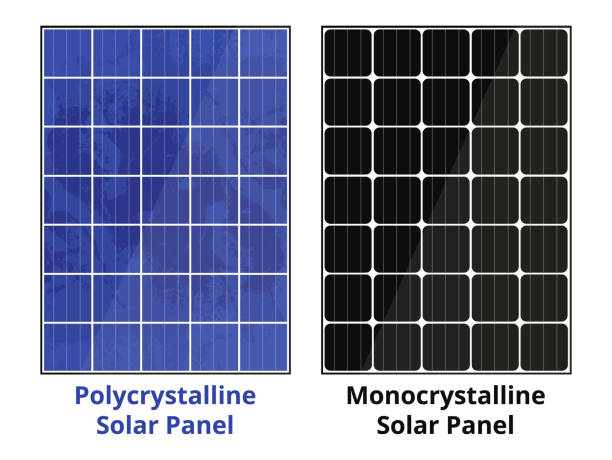
Monocrystalline panels are made from a single silicon crystal, often referred to as “monosilicon.” This purity allows for high efficiency because electrons can move more freely, which maximizes power output.
Polycrystalline panels are made by melting silicon fragments together. While simpler to produce and less costly, the multiple crystals restrict electron movement, leading to lower efficiency.
| Factor | Monocrystalline Solar Panels | Polycrystalline Solar Panels |
|---|---|---|
|
Silicon Structure |
Made from a single crystal of silicon |
Made from multiple silicon fragments melted together |
|
Efficiency |
Generally higher (16% to 24%) |
Lower efficiency (14% to 20%) |
|
Cost |
More expensive ($0.50 to $0.80 per watt) |
Less expensive ($0.40 to $0.50 per watt) |
|
Appearance |
Black hue, sleek design |
Blue hue, often considered less aesthetically pleasing |
|
Temperature Coefficient |
Lower, performs better in high temperatures |
Higher, less efficient in heat |
|
Lifespan |
25 to 40 years |
20 to 35 years |
The core difference lies in the crystal structure:
Efficiency in solar panels is crucial, especially for homes with limited roof space.
The upfront cost differs significantly between these types:
Homeowners often consider aesthetics:
The temperature coefficient is a measure of how much efficiency drops as temperature rises.
Both panel types have impressive durability but vary slightly in lifespan:
For properties with limited roof space, monocrystalline panels maximize output per square meter, reducing the need for numerous panels. Polycrystalline panels may require more roof area to meet the same energy needs, so they’re best for properties with ample roof space.
For regions with frequent high temperatures, monocrystalline panels retain efficiency better. In cooler climates, polycrystalline panels provide sufficient performance without the added cost, making them a practical choice.
Although monocrystalline panels have a higher initial cost, they frequently yield better ROI due to efficiency and lifespan. In comparison, polycrystalline panels offer a quicker payback period due to the lower upfront cost but may need more replacements, impacting long-term savings.
In conclusion, the best panel type depends on factors like budget, roof space, climate, and longevity expectations. Monocrystalline panels offer superior efficiency and aesthetic appeal, while polycrystalline panels are ideal for those prioritizing affordability.
Monocrystalline panels are made from a single silicon crystal, making them more efficient, while polycrystalline panels are made from multiple crystals, which lowers efficiency but reduces cost.
Yes, especially for those needing high efficiency in limited space or seeking long-term value. Monocrystalline panels typically have a longer lifespan and better performance.
Polycrystalline panels perform well but may experience efficiency loss in high temperatures. They are well-suited to cooler climates and installations with plenty of space.
Monocrystalline panels require more resources and energy to manufacture, but they offer long-term energy savings. Polycrystalline panels, while easier to produce, may need more frequent replacements.
Consider your budget, available roof space, climate, and energy needs. Monocrystalline panels are ideal for small spaces with high energy demands, while polycrystalline panels suit larger, more open spaces with moderate energy needs.

Chat us on WhatsApp

We are here to help you with any inquiries or projects.


